
Organic Growth Built on Real Expertise
There are no shortcuts to sustainable search visibility. The brands that win in organic & AI search are the ones that invest in genuine expertise, build trust across every touchpoint, and let their authority speak for itself.
What Is E-E-A-T?
E-E-A-T stands for Experience, Expertise, Authoritativeness, and Trustworthiness – a quality framework introduced by Google in its Search Quality Rater Guidelines and used by over 10,000 human quality raters across 380,000+ annual evaluations to assess whether content genuinely deserves to rank. E-E-A-T appears 120 times in the Quality Rater Guidelines.
Google updated the original E-A-T framework in December 2022 by adding “Experience” – signaling that first-hand knowledge matters just as much as credentials. But the most critical element sits at the center of the entire framework: Trust. As Google states directly, “of these aspects, trust is most important. The others contribute to trust, but content doesn’t necessarily have to demonstrate all of them.”
E-E-A-T is not a score. It’s not a metric you can game. It’s a lens through which Google evaluates whether your brand, your content creators, and your website deserve the visibility you’re seeking – especially for topics that affect people’s health, finances, safety, and well-being.
I believe focusing on E-E-A-T is the best way to future-proof your SEO/AI search strategy, as search engines and large language models will increasingly seek out high-quality, trustworthy, authoritative information made by rea human experts over time.
How True Expertise Drives Organic Growth
Since the ‘Medic Update’ in August 2018, Google has evolved to reward websites and content creators who demonstrate genuine subject-matter expertise. Google has also launched various core updates, along with the Helpful Content Update, to try to sift through low-quality, untrustworthy, spammy sites to ensure high-quality, authoritative, trustworthy content from real experts and experienced creators rises to the top.
This isn’t speculation. It’s a pattern I’ve tracked across every major core update, product reviews update, and Helpful Content Update over the past eight years.
The data tells a clear story: authentic authorities, such as trusted institutions, the actual practitioners, and the people doing the work, consistently gain rankings over time, while sites that try to manufacture authority through superficial tactics (fake author bios, backdated content, claimed credentials that don’t exist) eventually lose.
Google evaluates expertise at the entity level, not just the page level. Through technologies like Agent Rank, Author Vectors, and Speaker Identification, Google can assess who you are, what you’ve published, where you’ve been cited, and whether you’re a recognized authority in your space, even without an explicit byline on every page. I wrote about this in a joint article with the late, great SEO and Google Patent expert, Bill Slawski, in 2020:
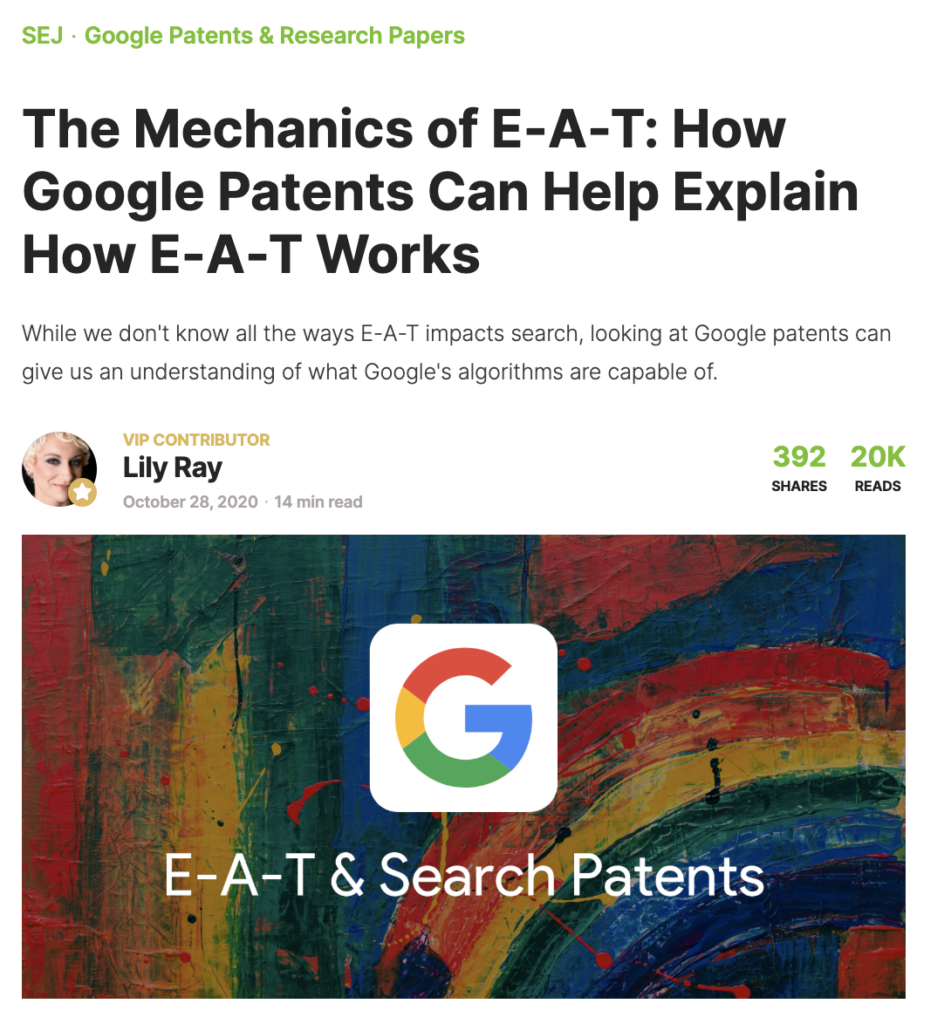
This means the SEO game has fundamentally evolved. You can’t optimize your way around a lack of real expertise. But if you have it, if your brand employs genuine experts, produces original research, and has earned recognition in your industry, there has never been a better time to leverage that for organic growth.
The E-E-A-T Method: Growth Without Shortcuts
Too many SEO strategies chase algorithm loopholes that expire with the next update. The E-E-A-T Method is fundamentally different. It’s a long-term investment in making your brand’s real qualities impossible for search engines and AI systems to ignore.
The approach I use with clients is grounded in a simple philosophy: make the good things about your brand, your leadership, your experts, and the people behind your content as prominent and verifiable as possible, across every channel where search engines and AI systems look.
This means clearly communicating who your experts are and why they’re qualified. It means investing in original research rather than repackaging what already exists. It means building author authority and a legitimate social media presence that connects real people to the content they create. And it means ensuring your brand’s narrative is consistent across your website, social platforms, press coverage, industry publications, and every other surface where your reputation lives.
When individual experts build a visible, credible presence by speaking at conferences, publishing original insights, and earning recognition in their field, the brands they represent grow with them. Expert visibility and brand growth are not separate strategies. They are interconnected.
Showcase Real Experts
Surface the people behind your content with detailed author profiles, consistent bios across platforms, and transparent credentials. Google recognizes individual experts as distinct entities. Give it the signals to connect your people to their authority.
Produce Original Research
Become a primary source, not an aggregator. Original data, proprietary studies, and first-hand analysis are the content signals that earn citations, backlinks, and trust from both human audiences and AI systems.
Build Brand Consistency
Your website, social profiles, press mentions, partner pages, and external communications should all tell the same story. Clear, consistent language about who you are and what you do gives search engines and LLMs the confidence to surface your brand.
Earn Third-Party Validation
Authoritativeness isn’t self-declared. It’s earned when credible sources cite you, link to you, and mention you as a go-to resource. Strategic digital PR, industry contributions, and thought leadership create the external signals that algorithms and AI models rely on.
E-E-A-T in the Age of AI Search
The rise of AI-powered search, including Google AI Overviews, ChatGPT, Gemini, and Perplexity, hasn’t made E-E-A-T less important. While there are certainly loopholes being exploited in AI search, we are still in the early days of this technology, and LLMs will undoubtedly aim to mitigate spam and seek out content that demonstrates E-E-A-T over time. Just like Google’s ranking systems did.
AI search is multimodal. Modern large language models don’t just read your website. They ingest video transcripts, podcast audio, social media posts, images, forum discussions, review platforms, and press coverage. They see your YouTube presence, your LinkedIn activity, your Reddit mentions, and your conference talks. Your entire online footprint, not just your website, is now the surface area for discovery.
This changes what organic marketing means. Brands that only optimize their website are optimizing for a fraction of the signals that AI systems use to decide who to cite, who to recommend, and who to trust. The brands that win are the ones with a dense, consistent web of expertise signals across every platform where audiences and algorithms look. This is an evolution of the “reputation management” work we’ve done in SEO for a long time.
Answer Engine Optimization (AEO) doesn’t replace SEO; it builds upon its foundation. Ranking well in traditional search increases your likelihood of being cited in AI-generated responses through retrieval-augmented generation. But AI systems also weigh third-party mentions, brand co-citations, and cross-platform authority in ways that go far beyond traditional link-building.
The metric that matters now is brand visibility, not just rankings. Share of voice across LLMs, citation rates in AI answers, and the consistency of your brand narrative across the web are the new competitive benchmarks. The E-E-A-T approach is how you build for all of them simultaneously.
My Work on E-E-A-T
I’ve been researching, writing, and speaking about E-E-A-T since Google’s Medic Update in 2018. Here’s a selection of the work that has shaped my approach.
Conference Presentations
MozCon 2022: “Why Real Expertise Is the Most Important Ranking Factor of Them All,” a data-driven deep dive into how Google evaluates expertise at the entity level and why authentic authority consistently outperforms tactical SEO.
MozCon 2021: “How the E-A-T Ecosystem Has Transformed Organic Search from the Medic Update to Now,” a comprehensive analysis of how Google’s emphasis on authority reshaped the SEO landscape across search, News, Discover, and YouTube.
Research & Writing
E-E-A-T Guide: A comprehensive resource covering Google’s framework, optimization strategies, common misconceptions, and how E-E-A-T intersects with YMYL topics and algorithm updates.
SEO, GEO & AI Search: A reflection on how AI search is reshaping organic marketing, and why the fundamentals of E-E-A-T remain the foundation of visibility in an AI-driven landscape.
Plus ongoing contributions to Search Engine Journal, Search Engine Land, Amsive Insights, and industry publications tracking algorithm updates, core update winners and losers, and the evolving role of authority in search.
Build Your E-E-A-T Strategy
Whether you’re recovering from a core update, preparing for AI search, or building long-term organic visibility from the ground up, the E-E-A-T approach is how sustainable growth starts. Let’s talk about your brand.