
It works, until it doesn’t.
SEO & GEO recovery audits and strategy for sites hit by Google algorithm updates, including the growing wave of sites burned by risky GEO and AI search tactics.
Your traffic dropped and you think your SEO/GEO strategy is to blame…
Many sites that lose visibility in an algorithm update don’t realize that the same tactics they used to scale their SEO/GEO success are the thing that came back to bite them six months later. Scaled AI content, self-promotional listicles, scaled comparison/alternative pages, scaled local landing pages, and other excessive programmatic page templates can drive real growth at first, which is exactly why teams typically double down on them. Then a core update or algorithmic adjustment rolls out, and the growth reverses into a decline that’s often steeper than the climb.
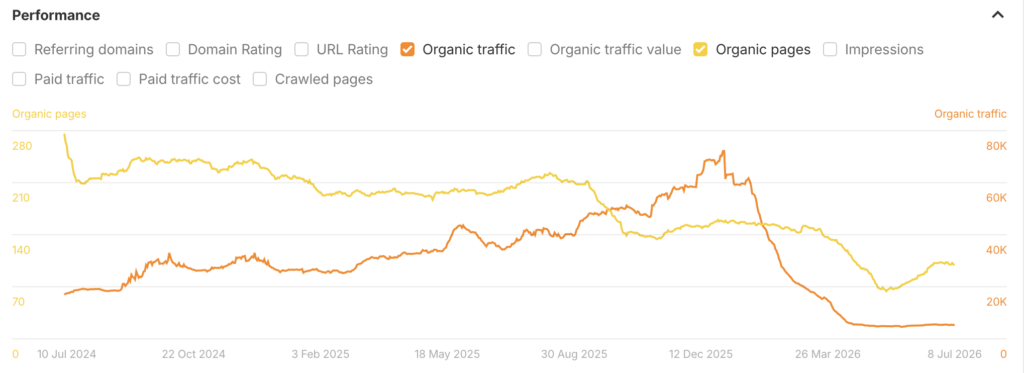
I’ve written about this boom and bust cycle for at least ten years, and often use the phrase “it works, until it doesn’t” to describe this familiar growth pattern. I’ve also presented about this topic extensively at SEO and AI search conferences.
I’ve spent over a decade helping companies recover from Google algorithm updates and manual actions. In the past year, I’ve documented a new version of an old pattern: many of the tactics being sold as generative engine optimization (GEO/AEO) are the same tactics that got sites flattened by the Helpful Content Update and the March 2024 core update, repackaged with a new name. My research tracking 220+ websites using AI content scaling tools found that 54% lost 30% or more of their peak organic traffic, and 22% lost 75% or more. Furthermore, many of the new tools
Because AI search engines retrieve content from the same search indexes that power organic rankings, losing SEO visibility means losing AI visibility too. Recovery isn’t a choice between the two; restoring one helps restores both.
This SEO/GEO recovery service is for you if:
Your traffic dropped during (or shortly after) a Google core update, spam update, or a period of unconfirmed ranking volatility, and it hasn’t come back.
You used AI tools to rapidly publish hundreds or thousands of articles, comparison pages, glossary entries, or FAQ pages, and growth reversed into decline.
Your site publishes “best of” articles ranking your own company #1, a tactic Google began visibly demoting in early 2026.
You hired a consultant or agency promising AI citations and mentions, and their playbook left you with a content footprint that looks like spam to search engines.
You received a manual action in Search Console and need help with cleanup and the reconsideration request process.
Your citations and mentions in ChatGPT, Gemini, and AI Overviews are declining alongside your organic search rankings.
The SEO & GEO tactics that work, until they don’t
Every few years since the dawn of SEO, the search industry rediscovers the same shortcut: publish more, faster, at scale. AI has made that shortcut cheaper and more tempting than ever, and an entire GEO industry has emerged to sell it. But Google has spent over two decades building systems specifically designed to detect and demote manufactured visibility, and the LLM platforms built on top of search inherit those demotions. I have been helping clients deal with exactly this cycle since my early days in SEO.
In my research, the sites seeing the steepest declines since the dawn of AI search share a recognizable footprint: excessive self-serving listicles, comparison and “alternatives” pages published at scale, one-question-per-URL FAQ farms, programmatic glossaries and location pages, artificially refreshed dates, off-topic content, and AI-generated articles that add nothing beyond what already ranks. Some have gone further into tactics Microsoft and Google now formally classify as prompt injection: hiding instructions inside “Summarize with AI” buttons to manipulate what AI assistants say about their brand.
None of this means your site is beyond saving. Recovery is possible if you know which parts of your site to improve (and if you’re willing to put in the work and wait patiently for the results).
The algorithm update / GEO recovery process
1. Forensic audit
I analyze exactly when and where the decline happened: which updates, which subfolders, which content types, using visibility data and pattern analysis refined across hundreds of update-affected sites over 10+ years of specializing in this work.
2. Root cause diagnosis
Algorithm update impacts are almost never one thing. I evaluate content quality, E-E-A-T signals, technical foundations, and any risky SEO/GEO tactics in play, and separate the true causes from the noise.
3. Prioritized remediation plan
I deliver a concrete roadmap: what to remove, prune, consolidate, rewrite, and rebuild, sequenced by impact. Content removal is often one of the most powerful and underused recovery levers.
4. E-E-A-T rebuild
Recovery usually involves amore than just cleanup. We rebuild the expertise, experience, authoritativeness, and trust signals that Google’s systems and AI platforms reward long-term.
5. Monitoring through updates
Meaningful recovery is often only visible when Google runs subsequent core updates. It can often take 6-12 months to see a meaningful recovery after the recommended changes have been implemented.
Recovery can takes 6–12 months or more.
Sites affected by core updates typically can’t fully recover until Google runs subsequent updates and re-evaluates the site, and that re-evaluation only goes your way if the underlying problems have genuinely been fixed. In my experience across a decade of recovery work, meaningful recovery usually takes six to twelve months or more. Occasionally it’s faster. Sometimes, for the most damaged sites, it takes longer. This is why the safest thing to do is not get hit by algorithm updates in the first place.
I tell you this upfront because the recovery space is full of the same people who caused these problems: promising quick fixes, guaranteed timelines, and “GEO hacks” to shortcut the work. There is no shortcut. There is a proven process, applied consistently, measured honestly.
Recoveries I’ve led
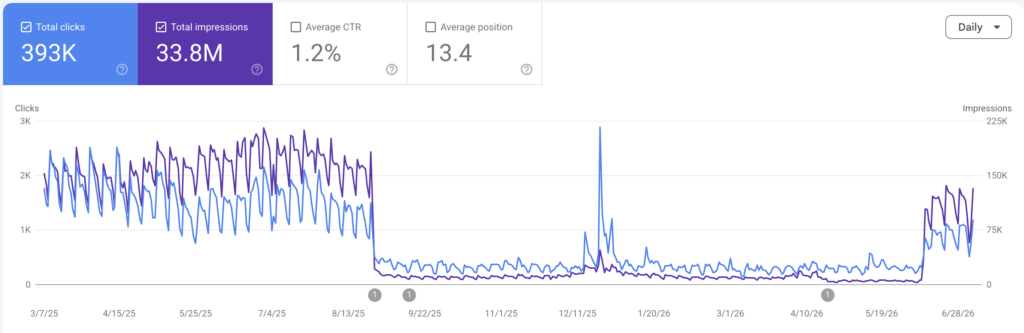
B2B: December 2025 Spam Update: A B2B commercial mail receiving agency that provides digital mail forwarding services to expatriates, digital nomads, and international shoppers. The site’s previous SEO agency had scaled problematic content meant to rank in search engines but provide little to no value for users. The site was hit by the December 2025 Spam Update, and after implementing improvements throughout early 2026, they saw a significant recovery in June 2026.
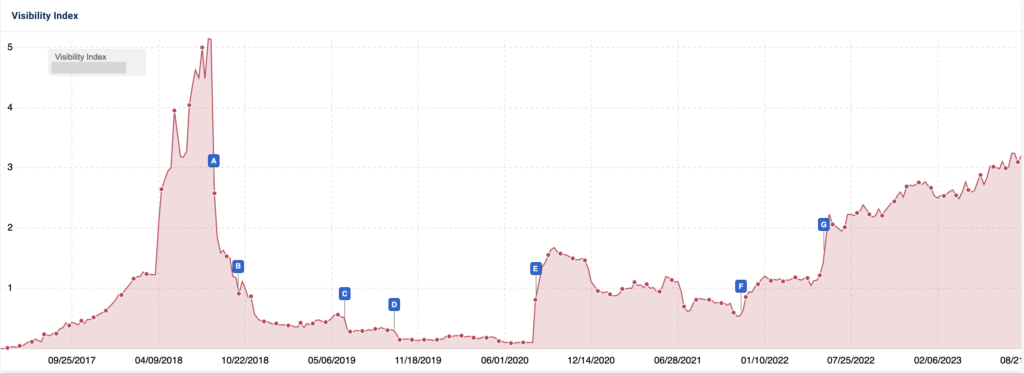
Health software company: the August 2018 “Medic” update destroyed the visibility of this health software company, which was scaling duplicate content across its site. My team at Amsive and I worked with the client to build out a new site focused on high-quality, original content and demonstrating E-E-A-T. We won a Search Engine Land award for this project; the site took two years to fully recover.
I’ve been doing recovery work since before it had a hype cycle.
Algorithm update recovery has been central to my consulting work for over a decade: through the Penguin update, Medic, the core update era, the Helpful Content Update, and the March 2024 update that Google said reduced unhelpful content in results by 45%. My research on update impacts and AI content risks is cited across the industry.
I don’t take shortcuts or use tactics that put your site at risk. Every recovery engagement is grounded in the E-E-A-T Method, because the only durable way out of an algorithmic demotion is to become a site Google and AI systems genuinely want to surface.